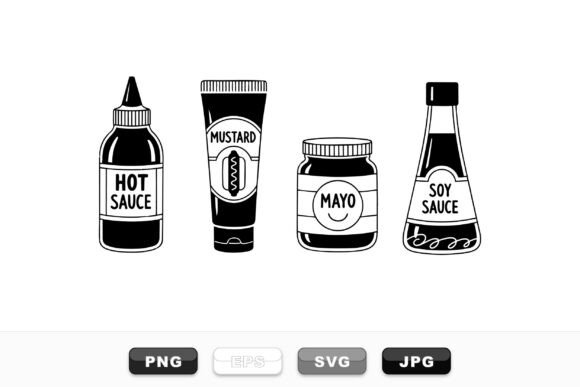
Retro Condiment Bottles Clipart Set
As a designer who spends half my life staring at stitch density charts and the other half arguing with thread tension, I don’t just buy clipart—I evaluate it for survival. Can this design actually be stitched? Will it hold up after twenty washes? Does it look like a professional asset or a rushed afterthought? When I pulled up the Retro Condiment Bottles Clipart Set, I wasn’t looking for pretty pictures. I was looking for a viable machine embroidery design that could anchor a small business collection without falling apart under the needle.
The premise is simple: flat black and white vector illustrations of hot sauce, mustard, mayo, and soy sauce containers. Minimalist style. Clean lines. Bold labels. On paper, this sounds like a perfect candidate for high-contrast applique work or bold satin-stitch outlines. But does it translate to fabric? Let’s break down how this embroidery file performs in real-world scenarios, from Etsy listings to craft fair tables.
First Impressions: Mood and Visual Personality
The immediate appeal of this set lies in its graphic clarity. In the world of embroidery, complexity is often the enemy of longevity. Intricate gradients and fine shading require expensive threads and precise machine calibration. This set, however, leans into bold geometry. The minimalist aesthetic suggests a modern, slightly nostalgic vibe—think mid-century diner meets contemporary kitchen decor. It feels approachable, fun, but structured enough to command respect on a finished product.
For a craft business owner, this visual personality is gold. It doesn’t scream "loud" or "chaotic." Instead, it offers a clean canvas that pairs well with denim, canvas, or crisp cotton. The black-and-white theme allows you to inject your own brand colors through thread selection, making it a versatile design asset rather than a rigid, single-color image. It creates a mood of casual sophistication, perfect for a boutique that wants to sell more than just basic merchandise.
Real-World Application: Where This Design Shines
I put this concept through the wringer by imagining it on various substrates. Here is where the Retro Condiment Bottles Clipart Set truly earns its keep:
- Kitchen Linens and Aprons: This is the natural habitat for these designs. Imagine a set of embroidered tea towels featuring the soy sauce and mustard bottles. The high contrast works beautifully on white or cream linen. It elevates a simple kitchen towel into a personalized gift that looks curated rather than mass-produced.
- Tote Bag Design: A heavy-duty canvas tote with a cluster of these condiment bottles stitched in vibrant reds, yellows, and blues stands out. Because the underlying vector art has strong silhouettes, even a simplified applique design version would read clearly from a distance. It’s an eye-catching addition to any market stall.
- Sweatshirt Embroidery: For those cozy, oversized hoodies, a small chest pocket placement of the hot sauce bottle adds a playful touch. The clean lines ensure that the design doesn’t get lost in the texture of fleece or French terry. It adds personality without overwhelming the garment.
- Baby Embroidery: Yes, really. There is something charming about pairing cute, stylized food items with baby gear. A onesie with a tiny mustard bottle isn’t just funny; it’s memorable. The minimalist style ensures the design remains age-appropriate and not too cluttered for delicate fabrics.
- Commercial Embroidery Projects: If you are designing for a local diner or a food truck, this set provides a cohesive visual language. You can mix and match the bottles to create custom uniforms or promotional patches. The consistency in line weight across all four bottles means they will look like a unified brand identity.
The Critical Analysis: Stitching Challenges and Constraints
No design is perfect, and as a reviewer, I have to point out where things might go wrong. The Retro Condiment Bottles Clipart Set relies heavily on clean lines and bold shapes. While this is great for visibility, it presents specific challenges depending on your setup.
Small Hoop Sizes: If you attempt to stitch these designs in a very small hoop (under 4x4 inches), you risk losing the integrity of the label details. The text on the bottles, if present, needs to be legible. If the digitization compresses the lettering too much, it becomes a blurry mess. Always check the stitch density before committing to a small size. If the text is too small, consider using a larger font or simplifying the label graphic.
Fabric Texture and Stretch: These designs demand stability. Trying to embroider these clean lines on a highly textured fabric like chunky knit wool or a stretchy jersey without proper support will result in puckering. Distorted lines ruin the minimalist aesthetic instantly. You need a sturdy stabilizer—likely a cut-away for stretchy fabrics or a high-quality tear-away for woven cottons—to keep those straight edges straight.
Thread Color Contrast: Since the source is black and white, the success of the final product hinges entirely on your thread choice. Black thread on dark fabric is invisible. White thread on light fabric lacks definition. To make this embroidery project pop, you must choose threads that offer sharp contrast against your base material. This is also where you can get creative: use a bright yellow for the mustard bottle to make it jump off a navy blue cap.
Dense Stitch Areas: If the design uses fill stitches for the bottle bodies, be wary of excessive bulk. Thick layers of thread can make the fabric stiff and uncomfortable, especially on apparel like custom apparel shirts or hats. Ensure the digitizer has balanced the stitch count so the fabric remains drape-friendly.
Practical Designer Notes for Execution
Before you hit the start button on your machine, take these steps to ensure your finished product meets professional standards:
- Test on Scrap Fabric: Never assume a design will work on your final substrate. Run a test stitch on the exact fabric type you plan to use. Check for puckering, thread breaks, and color accuracy.
- Inspect Small Details: Zoom in on the digital preview. Are the corners of the bottles rounded or sharp? Do the label lines intersect cleanly? Poorly executed intersections can cause thread bunching.
- Confirm Licensing: As an Etsy seller or small shop product creator, you must verify the commercial usage rights. Does the license allow you to sell physical items made from this design? Some digital embroidery files restrict resale, while others permit it with attribution. Protect your business by reading the fine print.
- Mockup Visualization: Before investing time in stitching, place the vector art onto printable mockups of totes, aprons, and pillows. See how the layout balances with other elements. Does it feel crowded? Is there enough negative space?
- Stabilizer Selection: Match your stabilizer to your fabric weight. Heavy fabrics need heavy stabilization. Light fabrics need lightweight support. Using the wrong stabilizer is the fastest way to ruin a good design.
Final Verdict: Is It Worth the Investment?
The Retro Condiment Bottles Clipart Set is a solid, practical addition to any designer’s library. It isn’t trying to be a photorealistic masterpiece; it is doing exactly what a good graphics asset should do—it communicates a clear idea with efficiency and style. For makers who value clarity, versatility, and broad appeal, this set delivers.
It fits seamlessly into the categories of Crafts and Graphics, bridging the gap between digital art and tactile creation. Whether you are creating a holiday embroidery collection, updating your brand consistency for a new line of kitchen goods, or just looking for a fun handmade product idea, this design holds its own. Just remember: the magic happens in the execution. Respect the fabric, choose your threads wisely, and let the clean lines speak for themselves.