Retro Space Exploration Clipart Review
As a designer who spends half my life staring at stitch counts and the other half worrying about how thread tension interacts with knit fabrics, I don’t just look at an embroidery file; I look at its potential. When Retro Space Exploration Clipart landed in my inbox, my first instinct wasn’t to think about rockets or satellites. It was to think about texture, contrast, and the specific mood this sketch-style vector set could bring to a physical product. In a market saturated with glossy, high-tech space themes, there is a distinct hunger for something that feels hand-drawn, nostalgic, and authentic. This review breaks down exactly where this design fits in your workflow, how it translates from screen to fabric, and whether it deserves a spot in your commercial library.
The First Impression: Mood and Visual Personality
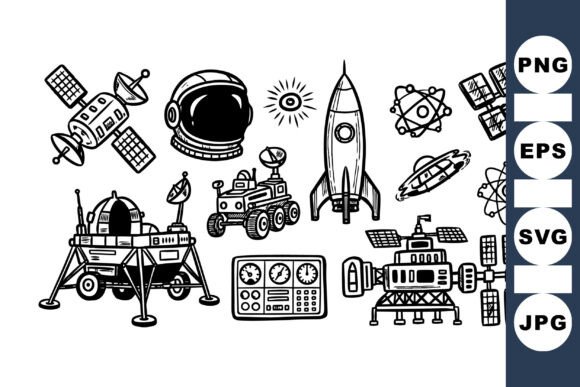
The moment you open the files, the aesthetic is clear. We are dealing with a black and white hand drawn vector set that captures the essence of mid-century scientific curiosity. The inclusion of rockets, satellites, rovers, and various scientific devices isn’t just about subject matter; it’s about line weight and personality. Unlike rigid, geometric clip art, these elements have a slight wobble—a human touch that suggests they were sketched on a napkin during a brainstorming session. For an embroiderer, this is crucial. Purely geometric shapes can sometimes look sterile when stitched, but sketch-style lines invite variation. They allow the thread to mimic the original pen strokes, creating a finished product that feels like a handmade artifact rather than a mass-produced sticker.
This visual language immediately positions the design for specific niches. It doesn’t scream "high-tech aerospace"; it whispers "educational creativity." It feels appropriate for a nursery, a maker’s studio, or a boutique shop that values storytelling over sleek minimalism. The monochromatic nature of the source material is actually a strength here. It forces the designer to make intentional choices about thread colors, which elevates the final piece from a simple decoration to a curated design asset.
Real-World Application: From Screen to Stitch
Let’s talk about practical use cases. Imagine you are preparing a custom embroidered tote bag for an Etsy listing targeting teachers or science enthusiasts. Retro Space Exploration Clipart works beautifully here. The sketch style pairs exceptionally well with canvas or heavy cotton blends, materials often used for durable totes. You might choose a single rocket motif placed centrally, or perhaps a scattered pattern of small satellites and stars across the entire front panel. Because the design elements are distinct, they hold their own against the rougher texture of canvas without getting lost.
Consider also the apparel decorator angle. A sweatshirt embroidery project featuring one of these rover or satellite designs can instantly give a garment a vintage, academic vibe. Think of it as a college club patch brought to life. The design fits naturally on the chest pocket area or centered on the back of a heavyweight hoodie. Similarly, for baby embroidery, this theme is timeless. A onesie or a burp cloth featuring a gentle, sketch-style rocket ship avoids the cluttered, neon-heavy look of many modern children’s designs. It appeals to parents who want something that looks good in a nursery photo and ages well as the child grows.
For the craft business owner, this graphic set is versatile enough for holiday embroidery projects. While space isn’t traditionally tied to holidays, the "exploration" theme works wonderfully for New Year’s resolutions or back-to-school seasons. An apron with a subtle satellite print could be a unique gift for a home cook who loves science. Even pillow covers benefit from this level of detail; the contrast between the dark thread and the lighter fabric mimics the original black and white vector style, creating a striking graphic impact that draws the eye.
Where Caution Is Required
No design is universally perfect, and Retro Space Exploration Clipart has specific constraints that every machine embroidery designer must respect. The most critical factor is hoop size. Sketch-style designs often rely on fine lines to convey their character. If you attempt to digitize or stitch this into a very small hoop, those delicate details will merge into a muddy blob. You need enough surface area for the running stitches and satin edges to breathe. If you are working on curved surfaces like caps or hats, ensure the design is simplified enough to follow the curve without distortion. Tiny lettering or intricate decorative accents within the scientific devices may not survive the stitching process if they are too dense or too small relative to the garment.
Fabric choice is equally important. Textured fabrics, such as bouclé or heavy tweed, can obscure the fine lines of a sketch design. Thin or stretchy fabrics require careful stabilizer selection to prevent puckering, which would warp the clean lines of the vector art. Dark fabrics present a different challenge; while classic, they demand high-contrast thread choices. If you use black thread on a black background, you lose the definition of the sketch. Conversely, using white thread on a dark fabric requires a topstitch or underlay that is robust enough to stay opaque and crisp after multiple washes.
Design Notes for the Professional Embroiderer
Before committing this design to a final product, professional diligence is non-negotiable. Always test the design on scrap fabric first. This allows you to check thread color contrast and review stitch density without risking your inventory. Inspect small details closely; do the satellites’ antennas stitch out clearly? Do the rover wheels maintain their shape? Test it in black and white mockups to ensure the composition reads well even if you decide to use a monochromatic thread palette later.
Confirm that the design works for both personal and commercial projects by checking the licensing terms provided with the download. Many digital embroidery files come with restrictions on how many finished items you can sell. As an Etsy seller or small shop product creator, violating these terms can lead to serious legal issues. Use proper stabilizer backing—cut-away for stretchy knits and tear-away for wovens—to maintain the integrity of the stitch work. Compare light and dark fabric backgrounds during your testing phase to see which yields the highest visual appeal and stitching clarity.
Final Verdict on Value and Appeal
Ultimately, Retro Space Exploration Clipart adds value through its distinct personality. In a sea of generic clip art, the hand-drawn quality builds customer trust and enhances handmade presentation. Buyers can sense the effort put into a design that feels curated rather than automated. This increases brand consistency for designers who specialize in vintage or educational aesthetics. Whether you are creating a printable mockup for a digital product preview or producing a limited run of embroidered patches, this design offers a professional finish that engages buyers.
It is not just a graphic; it is a foundation for a narrative. When a customer buys a tote bag or a sweatshirt featuring these elements, they aren’t just buying space imagery; they are buying a connection to a retro-futuristic ideal. For the creative entrepreneur, this means higher perceived value and stronger buyer engagement. Just remember to respect the technical limitations of embroidery. Keep your hoop sizes generous, your stabilizers appropriate, and your thread choices bold. If you treat this design with the care it deserves, Retro Space Exploration Clipart will serve as a reliable, attractive component in your catalog for years to come.